
How to Invest in Austin Real Estate for Lasting Returns
Finding the right approach to real estate investing in Austin can feel challenging when significant wealth is at stake and the city’s luxury neighborhoods are in high demand. Premium areas like Westlake and Tarrytown attract attention not only for their exclusivity but also for their enduring appreciation potential. By beginning with precise investment goals and a realistic budget, you set the foundation for long-term financial success and informed decision making in Austin’s competitive market.
Table of Contents
- Step 1: Define Your Investment Goals And Budget
- Step 2: Research Premium Austin Neighborhoods
- Step 3: Build Your Local Real Estate Network
- Step 4: Analyze Properties For Maximum ROI
- Step 5: Secure Financing And Close Your Deal
- Step 6: Evaluate Performance And Optimize Investments
Quick Summary
| Main Insight | Explanation |
|---|---|
| 1. Define Clear Investment Goals | Establish specific, measurable investment goals to guide your strategy and ensure accountability. |
| 2. Research Premium Neighborhoods | Focus on desirable areas like Westlake and Tarrytown to maximize growth and appeal. |
| 3. Build a Strong Local Network | Connect with local professionals to gain valuable insights into market dynamics and emerging opportunities. |
| 4. Analyze Properties for ROI | Use financial metrics like cash on cash return and capitalization rates for informed investment decisions. |
| 5. Optimize Investment Performance | Regularly assess performance and make adjustments to maximize returns and mitigate risks. |
Step 1: Define Your Investment Goals and Budget
Successful Austin real estate investing starts with crystal clear goals and a realistic financial blueprint. Investment goals help guide your strategy by providing a structured roadmap for your financial journey.
Begin by asking yourself critical questions about your investment expectations. Are you seeking short term appreciation, long term rental income, or a balanced approach? For high net worth investors targeting Austin’s premium neighborhoods like Westlake and Tarrytown, your goals might range from building generational wealth to creating passive income streams. Precise real estate investment objectives require understanding your risk tolerance, desired cash flow, and investment timeline.
When assessing your budget, consider not just purchase price but comprehensive expenses. This includes down payment, closing costs, potential renovation expenses, property taxes, insurance, and ongoing maintenance. Austin’s luxury market demands a comprehensive financial perspective that goes beyond simple acquisition costs. Factor in potential rental yields, appreciation rates, and tax implications specific to Central Texas real estate investments.
Pro tip: Use the SMART framework when setting investment goals to ensure they are specific, measurable, achievable, relevant, and time-bound, transforming abstract dreams into actionable investment strategies.
Step 2: Research Premium Austin Neighborhoods
Identifying the right neighborhood is crucial for successful real estate investment in Austin. Market insights reveal neighborhood dynamics that can significantly impact your investment potential.

Focus your research on premium neighborhoods that offer consistent growth and desirability. Areas like Westlake, Tarrytown, Lake Austin, and Downtown Austin represent prime investment targets with strong appreciation potential. Texas housing market data indicates that neighborhoods with excellent school zones, robust transit access, and proximity to employment hubs consistently outperform other areas. Look beyond surface level attributes and dig deep into local development plans, future infrastructure projects, and economic indicators that might influence property values.
Evaluate each neighborhood through multiple lenses: walkability, local amenities, cultural environment, and potential for long term appreciation. Consider factors such as proximity to tech corridors, entertainment districts, and quality of local schools. Pay attention to emerging neighborhoods that show signs of infrastructure improvements or upcoming commercial developments that could drive future property value increases.
Below is a comparison of premium Austin neighborhoods for real estate investment potential:
| Neighborhood | Notable Strengths | Typical Buyer Profile |
|---|---|---|
| Westlake | Top schools, quiet luxury | Family-oriented, high net worth |
| Tarrytown | Historic charm, central locale | Professionals, long-term investors |
| Lake Austin | Waterfront, exclusivity | Luxury seekers, retirees |
| Downtown Austin | Urban vibe, walkability | Young professionals, executives |
Pro tip: Create a comprehensive neighborhood comparison spreadsheet that tracks key metrics like median home prices, annual appreciation rates, rental yields, and local development plans to make data driven investment decisions.
Step 3: Build Your Local Real Estate Network
Establishing a robust professional network is fundamental to successful Austin real estate investing. Professional networks offer critical market insights that can transform your investment strategy from good to exceptional.
Start by strategically connecting with key local professionals who can provide nuanced market intelligence. Attend events hosted by the Urban Land Institute Austin chapter, join the Austin Board of REALTORS®, and participate in local real estate networking opportunities. Focus on building relationships with real estate agents specializing in premium neighborhoods like Westlake and Tarrytown, local property developers, mortgage brokers, and investment advisors who understand Central Texas market dynamics. These connections can provide insider information about emerging investment opportunities, upcoming development projects, and neighborhood transformation trends that are not publicly available.
Expand your network through targeted interactions such as industry conferences, local investment meetups, and professional association events. Leverage digital platforms like LinkedIn to connect with Austin real estate professionals, but prioritize in person interactions that allow for deeper relationship building. Follow local real estate thought leaders, engage in meaningful conversations, and demonstrate genuine interest in understanding the intricate Austin market landscape.
Pro tip: Develop a systematic approach to networking by setting a goal to meet at least two new professional contacts monthly and always follow up with a personalized email or coffee meeting to nurture those connections.
Step 4: Analyze Properties for Maximum ROI
Successful real estate investing in Austin requires a strategic and comprehensive approach to property analysis. ROI analysis demands sophisticated financial evaluation that goes beyond surface level metrics.
Develop a systematic framework for evaluating potential investments by examining key financial indicators. Detailed property analysis involves multiple strategic steps that help you understand true investment potential. Focus on critical metrics like cash on cash return, capitalization rate, internal rate of return, and net operating income. For Austin properties particularly in premium neighborhoods like Westlake and Tarrytown, consider additional factors such as potential appreciation, neighborhood development trajectories, and local market dynamics. Calculate projected cash flows by carefully analyzing rental income potential, estimated maintenance costs, property taxes, and potential vacancy rates.
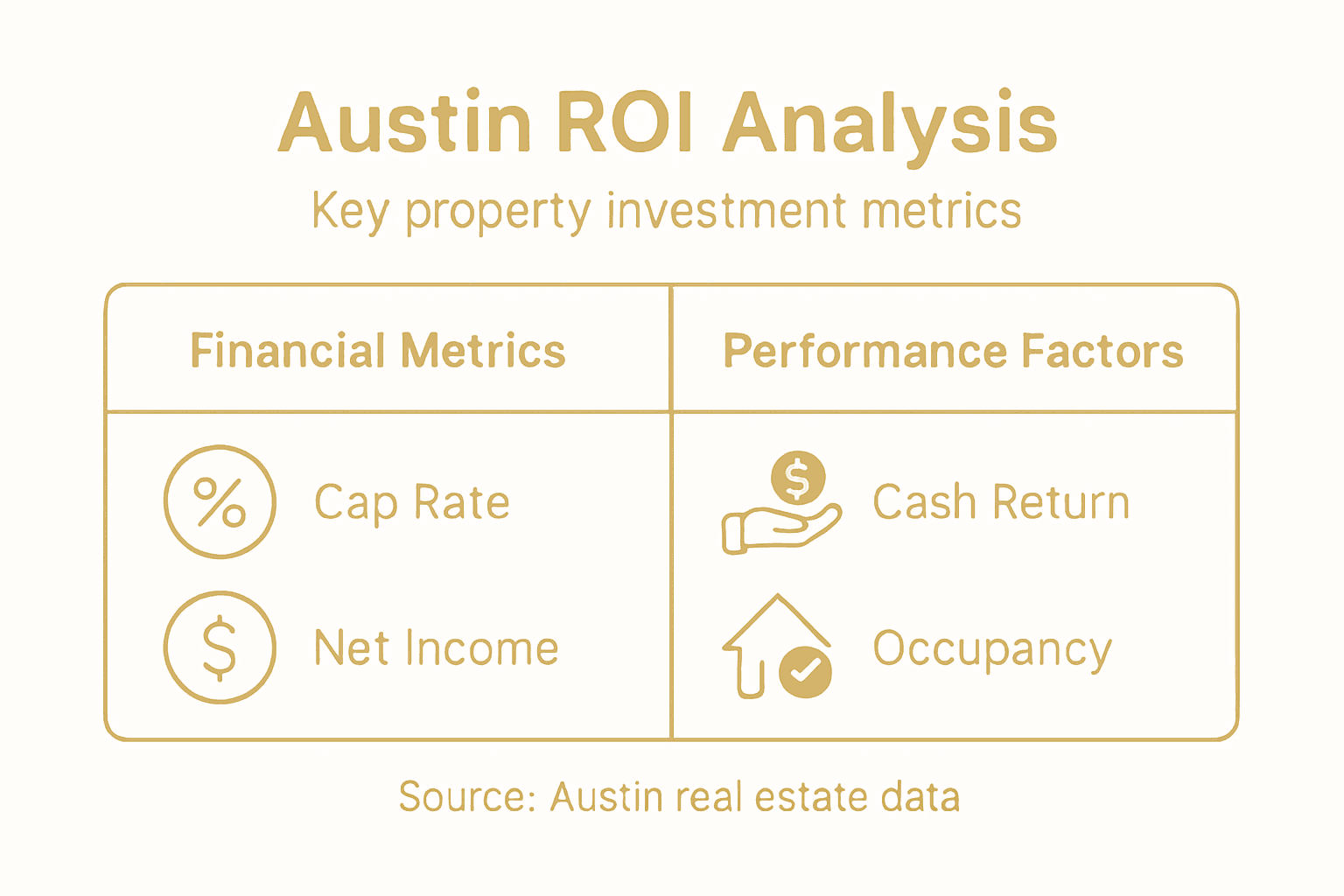
Leverage advanced analytical tools and technology to refine your investment strategy. Compare multiple properties side by side, using data driven approaches that account for both current market conditions and future growth potential. Examine historical price trends, upcoming neighborhood infrastructure projects, and economic indicators that could impact property values. Develop a comprehensive scoring system that weights different investment criteria based on your specific financial goals and risk tolerance.
Here’s a summary of key financial metrics for Austin property analysis:
| Metric | What It Measures | Significance in Investment |
|---|---|---|
| Cash on Cash Return | Annual pre-tax cash flow ÷ cash invested | Shows immediate income efficiency |
| Capitalization Rate | Net operating income ÷ property price | Assesses income yield potential |
| Internal Rate of Return | Discounted cash flows over investment life | Evaluates long-term profitability |
| Net Operating Income | Income after expenses, before taxes | Highlights true property earnings |
Pro tip: Create a standardized property analysis spreadsheet with weighted scoring criteria that allows you to objectively compare potential investments across multiple dimensions.
Step 5: Secure Financing and Close Your Deal
Closing a successful real estate investment requires strategic financial planning and expert navigation of complex lending landscapes. Real estate financing involves sophisticated legal instruments that demand meticulous preparation and understanding.
Approach financing by first assessing your financial position and exploring multiple lending options tailored to Austin real estate investments. Project financing solutions offer diverse strategic approaches for investors seeking premium properties in neighborhoods like Westlake and Tarrytown. Prepare a comprehensive financial portfolio that demonstrates your investment credibility, including detailed income documentation, credit history, existing asset valuations, and projected property performance metrics. Engage with local lenders who specialize in luxury Austin real estate and understand the nuanced market dynamics of Central Texas. Consider various financing structures including conventional mortgages, portfolio loans, and potentially creative financing options that align with your specific investment strategy.
Negotiate financing terms with precision, focusing on interest rates, loan duration, prepayment conditions, and flexibility. Work closely with financial advisors and real estate attorneys to ensure all legal and financial documentation is thoroughly vetted. Understand the full spectrum of closing costs, potential tax implications, and any specific requirements unique to Austin real estate transactions. Build relationships with multiple financial institutions to leverage competitive rates and terms that maximize your investment potential.
Pro tip: Maintain a robust financial profile by keeping detailed records of all transaction documentation and establishing strong relationships with multiple lending institutions to ensure flexibility in your investment approach.
Step 6: Evaluate Performance and Optimize Investments
Successful real estate investing requires continuous performance monitoring and strategic optimization. Advanced investment evaluation techniques provide investors with sophisticated tools to maximize returns and mitigate risks.
Develop a comprehensive performance tracking system that goes beyond basic financial metrics. Regularly analyze key indicators such as net operating income, cash flow, capitalization rates, and appreciation potential for each property in your Austin real estate portfolio. Focus on premium neighborhoods like Westlake and Tarrytown, understanding that each asset requires individualized assessment. Compare your property performance against local market benchmarks, tracking rental income, maintenance costs, property tax implications, and overall market trends. Utilize advanced financial modeling techniques to project future performance and identify potential optimization opportunities.
Implement a proactive approach to portfolio management by creating flexible investment strategies. This means being prepared to refinance properties, consider strategic improvements that increase property value, and potentially divest underperforming assets. Leverage technology and data analytics to gain deeper insights into market dynamics, using predictive modeling to anticipate future market shifts. Stay connected with local real estate professionals who can provide nuanced insights into emerging neighborhood trends and potential investment opportunities.
Pro tip: Create a quarterly investment review process that systematically evaluates each property’s performance against your original investment goals, allowing for timely strategic adjustments.
Unlock Lasting Returns with Expert Austin Real Estate Guidance
Investing in Austin real estate for lasting returns requires a clear vision, deep local knowledge, and strategic connections—challenges many investors face as they navigate budget planning, neighborhood selection, and ROI analysis. The article highlights how setting SMART goals, assessing neighborhoods like Westlake and Tarrytown, and building a strong network are critical steps to maximize investment potential. If you are seeking to turn these complex concepts into profitable actions, working with a team that combines a developer’s insight and a marketer’s savvy will make all the difference.
At Mogavero Group, founded by Mike Mogavero, we offer unparalleled, design-driven real estate expertise tailored to Austin’s premium neighborhoods. Our meticulous preparation and data-backed strategies help you confidently analyze properties and secure financing with a trusted network. Whether you want white-glove guidance in Westlake, Tarrytown, or the greater Austin market, our proven approach transforms investment challenges into lasting success.
Ready to elevate your Austin real estate investment journey with expert insight and tailored strategies? Explore how Mogavero Group can provide the clarity and connections you need to act decisively now. Contact us today to start building your lasting portfolio in Austin’s most desirable neighborhoods.
Frequently Asked Questions
What are the first steps to take in investing in Austin real estate?
Begin by defining your investment goals and budget. Consider what you want to achieve—whether it’s short-term appreciation or long-term rental income—and factor in all potential costs, including down payments and renovations, before proceeding.
How do I choose the right neighborhood for real estate investment in Austin?
Research premium Austin neighborhoods known for appreciation and desirability, such as Westlake or Tarrytown. Create a neighborhood comparison spreadsheet to track key metrics like median home prices and local amenities to make informed decisions.
What key financial metrics should I analyze when evaluating properties?
Focus on metrics like cash on cash return, capitalization rate, and net operating income to assess property value. Develop a standardized property analysis spreadsheet to objectively compare potential investments using these metrics.
How can I build a strong network for real estate investing in Austin?
Attend local real estate events and join professional associations to connect with key individuals in the market. Set a goal to meet at least two new contacts each month to strengthen your network and gain valuable insights.
What financing options should I consider for investing in Austin real estate?
Explore various lending options, including conventional mortgages and portfolio loans, that are tailored to real estate investments. Prepare a comprehensive financial portfolio to improve your chances of securing favorable financing terms.
How often should I evaluate my real estate investment performance?
Regularly analyze your investment performance at least quarterly to ensure your properties are meeting your financial goals. This includes reviewing metrics like rental income and market trends to make necessary adjustments.
Recommended
- Why Entrepreneurs Keep Choosing Austin: The Tarrytown Advantage | Blog | Mogavero Group
- How Federal Interest Rates Affect Luxury Property Values in Tarrytown | Blog | Mogavero Group
- East Austin Luxury For Sale | Short Term Rental | Mogavero Group
- Top Austin real estate agent | Austin relocation specialist