
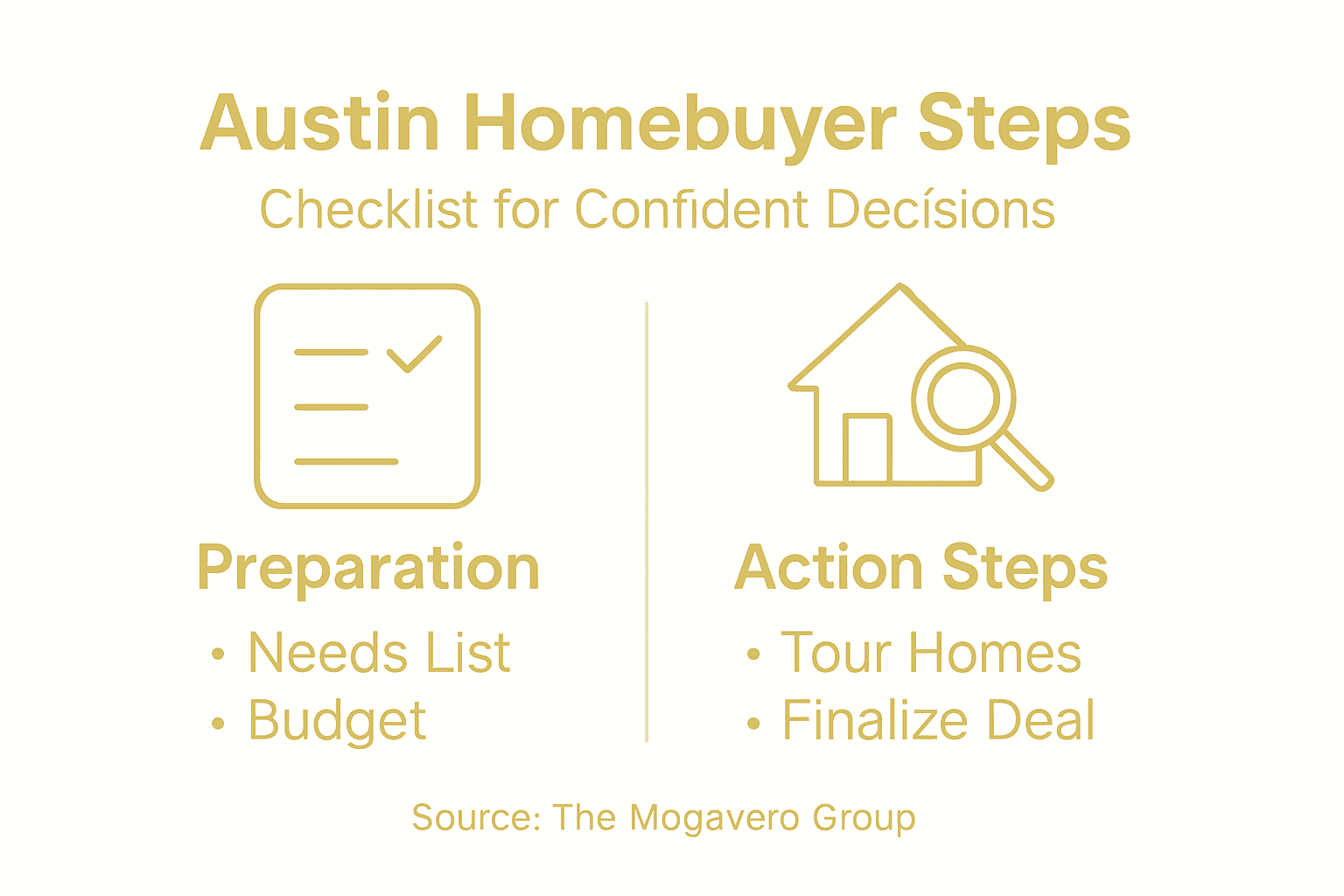
Complete Homebuyer Checklist Austin for Confident Moves

Moving from New York or San Francisco brings a unique set of expectations when searching for the right Austin home. Every detail, from neighborhood character to design quality, influences your next chapter. Austin offers both urban energy and serene, upscale corners, making it crucial to define what matters for your lifestyle. This guide empowers you to make informed, design-focused choices and discover neighborhoods and homes that truly match your vision, highlighting the importance of understanding local housing needs and preferences from the start.
Table of Contents
- Step 1: Assess Local Needs And Preferences
- Step 2: Secure Financing And Documentation
- Step 3: Partner With Trusted Austin Experts
- Step 4: Tour Homes And Evaluate Design
- Step 5: Verify Final Details And Close
Quick Summary
| Key Insight | Explanation |
|---|---|
| 1. Assess Local Needs Clearly | Understand neighborhood preferences and lifestyle fit before deciding on a property. This helps shape future choices beneficially. |
| 2. Secure Financing Beforehouse Hunt | Obtain pre-approval for your mortgage to enhance your buying power and streamline the purchasing process. |
| 3. Choose a Savvy Real Estate Partner | Collaborate with a knowledgeable agent familiar with Austin to navigate the competitive market effectively. |
| 4. Methodically Evaluate Homes | Use a systematic checklist when touring homes to compare critical features and avoid emotional decision-making. |
| 5. Thoroughly Review Closing Documents | Carefully scrutinize the closing disclosure to ensure accuracy and prevent any unexpected issues during finalization. |
Step 1: Assess Local Needs and Preferences
Before you commit to a neighborhood or property type, take time to understand what Austin actually offers and what genuinely matters for your lifestyle. This step shapes every decision that follows, from which neighborhoods feel right to what amenities you truly need versus what sounds nice in theory.
Start by identifying your core priorities. Are you drawn to walkable urban environments or do you prefer established residential neighborhoods with more space? Do you work downtown, or does your role allow flexibility across the city? Your daily commute, social circles, and work location matter far more than you might initially think.
Next, research the neighborhoods where you’re considering buying. Look beyond the glossy marketing and real estate listings. Walk the streets at different times of day. Visit local coffee shops, parks, and restaurants. Talk to residents who actually live there. Understanding the local housing needs and demographics helps you recognize whether a neighborhood aligns with your lifestyle, not just your budget.
Gather data on what matters to you:
- Proximity to your workplace, schools, or regular activities
- Walkability scores and access to dining, shopping, and entertainment
- Parks, trails, and outdoor recreation options
- Community feel and the types of neighbors you’ll have
- Future development plans that might change the area’s character
- Property tax rates and municipal services
Consider your budget realistically alongside neighborhood demand. In Austin’s competitive market, premium neighborhoods like Westlake and Tarrytown command higher prices for good reason—established infrastructure, design quality, and community stability. Understanding what housing affordability pressures exist in your target area helps you set realistic expectations.
Here’s how Austin’s popular neighborhoods compare on key attributes:
| Neighborhood | Community Feel | Average Home Price | Accessibility |
|---|---|---|---|
| Westlake | Established, upscale | High, premium segment | Quick to downtown |
| Tarrytown | Quiet, classic | High, historic area | Central, walkable |
| Downtown Austin | Urban, lively | Medium to high | Walkable, transit |
| South Austin | Vibrant, eclectic | Moderate | Easy highway access |
Connect with a local real estate advisor who knows Austin’s neighborhoods intimately. The Mogavero Group team has deep roots in Central Austin and can walk you through how different areas actually feel living there, not just how they photograph.
One final reality check: your needs shift. Life changes. Before falling in love with a specific property or neighborhood, ask yourself whether this location works for your next three to five years, not just today.
Pro tip: Create a personal priorities list ranking what matters most—commute time, outdoor space, walkability, or resale potential—then use it to filter neighborhoods objectively rather than emotionally.
Step 2: Secure Financing and Documentation
This step determines what you can actually afford and proves to lenders that you’re a qualified buyer. Getting your finances and paperwork in order before house hunting saves weeks of delays and prevents losing out on competitive offers.
Start by checking your credit score and credit report. Your score directly impacts your mortgage interest rate, which affects your monthly payment and total loan cost. A score of 620 or higher typically qualifies for conventional financing, but lenders prefer 740 or above for the best rates. Pull your free credit report from all three bureaus and dispute any errors you find.
Next, gather your financial documentation. Lenders need proof of income, employment history, and assets. This typically includes:
- Last two years of tax returns
- Recent pay stubs and W-2 forms (or business tax returns if self-employed)
- Bank statements showing savings and down payment funds
- A list of current debts and monthly obligations
- Proof of employment from your current employer
Understanding mortgage types and loan options helps you choose the right financing structure for your situation. Fixed-rate mortgages offer predictability, while adjustable-rate options might lower your initial payment but carry rate-change risk. Conventional loans differ from FHA loans in down payment requirements and flexibility.
Below is a summary of major mortgage types and their characteristics:
| Mortgage Type | Down Payment | Interest Rate Structure | Typical Borrower |
|---|---|---|---|
| Conventional | 5-20% | Fixed or adjustable | Broad, strong credit |
| FHA | 3.5% | Usually fixed | First-time, flexible credit |
| Jumbo | 20%+ | Fixed or adjustable | Luxury, high-price area |
| VA | 0% | Fixed | Veterans, active duty |
Get pre-approved by a mortgage lender, not just pre-qualified. Pre-approval means a lender has actually reviewed your finances and documents, giving you a verified borrowing amount and a formal letter. This dramatically strengthens your offer when you find a property. Pre-qualification is just an estimate and carries little weight in competitive situations.
Consider working with a mortgage broker who understands Austin’s market and luxury properties. They can shop multiple lenders on your behalf and navigate the specific documentation requirements that come with higher-value homes in neighborhoods like Westlake and Tarrytown.
Review preparing your financial documentation carefully before submitting to lenders. Inconsistencies or missing information delays approval. Have everything organized and ready before you start seriously shopping for homes.
Getting pre-approved before house hunting puts you in control of the process instead of scrambling after you find “the one.”
Pro tip: Request pre-approval from at least two lenders to compare rates and terms, then ask each lender about lock-in periods to protect your rate while you search for your home.
Step 3: Partner with Trusted Austin Experts
The right real estate advisor transforms your home search from overwhelming to confident. A knowledgeable partner handles the complex mechanics of Austin’s market, protects your interests, and helps you avoid costly mistakes.
Start by identifying agents with deep local expertise. Generic national franchises cannot compete with professionals who understand Austin’s unique neighborhoods, market cycles, and design-forward communities. Look for agents who specialize in your target areas like Westlake, Tarrytown, or Downtown Austin and have proven transaction history there.
Evaluate credentials and experience. Licensed realtors affiliated with established local real estate boards bring accountability and access to exclusive market data. Ask potential agents how long they have operated in Austin and request references from recent clients in neighborhoods where you plan to buy.
When interviewing agents, assess these qualities:
- Genuine knowledge of neighborhood character, not just statistics
- Understanding of luxury properties and high-value transactions
- Transparent communication about market conditions and pricing
- Network connections for inspectors, lenders, and title companies
- Responsiveness to your timeline and preferences
- Proven negotiation results on behalf of buyers
The best Austin real estate partners think like both developers and marketers. They understand design quality, architectural merit, and what creates lasting value. They can read a market, identify emerging neighborhoods before they peak, and position you strategically.
Look for advisors who see your purchase as a partnership, not just a transaction. You want someone who walks neighborhoods with you at different times of day, explains what you are really looking at beneath surface appeal, and advocates fiercely during negotiations. This requires personal investment in your success, not commission-driven rushing.
Consider working with a team rather than a single agent. A strong group like the Mogavero Group brings architects, designers, and market strategists who elevate the entire buying experience and provide insights beyond traditional real estate advice.
The right advisor becomes your trusted guide through Austin’s competitive market, turning uncertainty into clarity at every step.
Pro tip: Ask prospective agents to share recent comparable sales they negotiated and their average days on market for buyer transactions, then ask why their numbers outperform the Austin average.
Step 4: Tour Homes and Evaluate Design
This is where emotion meets evaluation. Home tours reveal whether a property matches your lifestyle, and careful assessment prevents buyer’s remorse after the purchase closes.

Prepare before your first tour. Review the listing details, property history, and neighborhood context. Bring a notebook or use your phone to photograph rooms, note details, and record your impressions while they’re fresh. Use a systematic home evaluation checklist to objectively compare features across multiple properties instead of relying purely on how a space makes you feel.
Walk through each home methodically. Look beyond the staging and furnishings to assess the actual bones of the property. Check for these critical design elements:
- Flow and layout. Does the floor plan work for your daily life, or does it force awkward traffic patterns?
- Natural light. Notice which rooms get morning and afternoon sun, and whether windows face desirable or undesirable views.
- Material quality. Examine flooring, cabinetry, and finishes for craftsmanship and durability, not just aesthetics.
- Storage and functionality. Are there adequate closets, pantry space, and built-ins, or will you immediately need renovations?
- Maintenance indicators. Look for water stains, cracks, outdated systems, or signs of deferred maintenance that hint at future costs.
- Outdoor integration. For Austin’s lifestyle, evaluate how well indoor and outdoor spaces connect.
Pay attention to what genuinely matters versus what marketing highlights. A stunning primary suite means little if the kitchen layout frustrates you daily. A resort-style pool loses appeal if the backyard lacks privacy or shade.
Take time during tours. Spend at least 20-30 minutes in each home, visiting at different times if possible to observe how light changes and how neighbors use their properties. This reveals character the listing photos never show.
After each tour, review your notes while the property is fresh in your mind. Compare how homes performed against your priorities checklist rather than relying on which one impressed you most emotionally.
The home that photographs beautifully is not always the home that lives beautifully for your specific lifestyle.
Pro tip: Visit a property at the same time of day you’ll typically be home to observe light quality, neighborhood activity, and traffic patterns in conditions that match your actual daily routine.
Step 5: Verify Final Details and Close
You’re in the final stretch. Closing is where the property legally becomes yours, but only if you carefully verify every detail and understand what you’re signing. This step protects your investment and ensures no surprises emerge after you have the keys.
About three days before closing, your lender must provide you with a Closing Disclosure form. Review this document carefully against your original loan estimate. Check that the interest rate, loan amount, monthly payment, and all fees match what you agreed to. Lenders sometimes make errors, and you need time to identify and correct them before closing day.
Request a final walkthrough of the property 24 hours before closing. This confirms that agreed-upon repairs were completed, that items stipulated in the contract remain in place, and that the home is in the expected condition. Bring a checklist and photograph any issues you discover so you have documentation if disputes arise.
Understanding the closing disclosure and post-closing responsibilities helps you navigate final steps confidently. This form details your actual loan terms, title transfer details, and all closing costs. Take time to review it line by line.
On closing day, bring these items:
- Valid government-issued photo identification
- Proof of homeowners insurance for the property
- Cashier’s check or wire transfer authorization for your down payment and closing costs
- List of questions about anything unclear on your closing documents
During closing, a title company or attorney will explain each document you sign. Do not sign anything you do not understand. Ask questions without hesitation. This is not the time to rush through paperwork.
After signing, funds transfer and the deed records with the county. You receive your keys, and the property is officially yours. Plan for this moment to coordinate with your lender, title company, and real estate agent to ensure smooth timing.
Within days after closing, set up automatic payments on your mortgage, schedule home maintenance inspections, and update your address with relevant institutions.
Closing is your final chance to catch errors. Read every document thoroughly and never sign something out of pressure or inconvenience.
Pro tip: Request a final copy of all closing documents at least one day before closing so you can review them carefully and identify any discrepancies before signing day arrives.
Navigate Austin Homebuying with Confidence and Expert Guidance
Buying a home in Austin demands more than enthusiasm. The challenges of evaluating neighborhoods like Westlake or Tarrytown, securing precise financing, and assessing design details can quickly become overwhelming. If you want to avoid costly surprises and ensure your choices align with your lifestyle and long-term goals, meticulous preparation is essential. The article “Complete Homebuyer Checklist Austin for Confident Moves” highlights the importance of clear priorities, thorough documentation, and trusted expertise every step of the way.

Partnering with the Mogavero Group means gaining access to a seasoned team deeply rooted in Austin’s design-driven real estate market. From insider knowledge of key neighborhoods like Downtown Austin to data-backed strategies and personalized support, Mike Mogavero’s approach transforms uncertainty into clarity. Don’t wait until you face competing offers or confusing paperwork. Start with a consultation to harness our white-glove guidance and ensure your next home is not just purchased but truly lived in with confidence. Explore more on our website and take the first step toward your Austin dream home today.
Frequently Asked Questions
What are the first steps to take when starting my homebuying journey in Austin?
Begin by assessing your local needs and preferences. Identify your core priorities such as commute time and community feel to narrow down suitable neighborhoods.
How can I secure financing before searching for a home in Austin?
Check your credit score and gather necessary financial documentation, including tax returns and bank statements. Get pre-approved for a mortgage, as this will strengthen your offer when you find the right property.
What should I look for during home tours in Austin?
Evaluate the design and functionality of each property, focusing on layout, natural light, and quality of materials. Use a systematic checklist to compare features across different homes to ensure a practical fit for your lifestyle.
How do I prepare for the closing process when buying a home in Austin?
Review the Closing Disclosure carefully a few days before closing to ensure all terms match your expectations. Conduct a final walkthrough of the property to confirm its condition and any agreed-upon repairs.
Why is it important to work with a local real estate expert in Austin?
A knowledgeable local agent can provide insights on Austin’s unique neighborhoods and help you navigate complex market conditions. Look for agents with proven expertise in your target areas to gain a competitive edge in your home search.
How can I ensure that I don’t miss any important steps during my homebuying process?
Use a complete homebuyer checklist that outlines each major step from assessing local needs to closing. Review this checklist regularly to track your progress and stay organized throughout the buying journey.