
Austin’s Real Estate Cycle: Impact on Luxury Buyers

Every luxury buyer knows that timing can be everything when investing in Austin’s exclusive property market. The city’s real estate cycle is far from predictable, shaped by economic shifts, population migration, and the powerful influence of the technology sector. This article illuminates the intricate phases and key myths behind Austin’s real estate cycle, offering high net worth individuals bold insight into what drives value and opportunity in one of Texas’s most dynamic luxury markets.
Table of Contents
- Defining Austin’s Real Estate Cycle And Market Myths
- The Four Phases Shaping Austin Property Trends
- Distinct Traits Of Austin’s Luxury Market Cycle
- Major Influences: Economy, Migration, And Policy
- Risks, Opportunities, And Timing Strategies
Key Takeaways
| Point | Details |
|---|---|
| Understanding Market Phases | Austin’s real estate market operates through four phases: Recovery, Expansion, Hyper Supply, and Recession, each with specific buyer behaviors and investment strategies. |
| Economic Influences | Factors such as economic diversity, migration trends, and policy changes significantly impact luxury property demand and value. |
| Complexity and Research Required | Investors must conduct thorough research and consult local experts to navigate the intricacies of Austin’s evolving real estate landscape. |
| Timing Strategies | Successful luxury buyers should develop dynamic investment strategies that account for market risks and opportunities, focusing on economic indicators and demographic shifts. |
Defining Austin’s Real Estate Cycle and Market Myths
Understanding Austin’s real estate market requires looking beyond simplistic narratives and examining the complex economic dynamics that drive property values and buyer behavior. The real estate cycle represents a nuanced progression through distinct market phases, influenced by economic indicators, population growth, and regional development trends.
Research from the Texas Real Estate Research Center reveals that Austin’s market is not a monolithic entity, but a dynamic ecosystem with interconnected components. Unlike static market perceptions, the real estate landscape continuously evolves through predictable yet intricate stages:
- Expansion Phase: Characterized by increasing demand, rising property values, and robust economic growth
- Peak Phase: Market reaches maximum price appreciation and development activity
- Contraction Phase: Slowdown in property transactions and potential price stabilization
- Trough Phase: Lowest point of market activity before renewal begins
Common market myths often misrepresent these cycles. Many luxury buyers mistakenly believe that real estate markets operate in linear, predictable patterns. However, economic data from the Bureau of Labor Statistics demonstrates that Austin’s market is influenced by complex factors like job market dynamics, migration trends, and technological innovation.
Key misconceptions include assuming that prices always increase, that market timing is straightforward, or that external economic shifts have minimal impact. In reality, Austin’s luxury real estate market requires sophisticated understanding of interconnected economic signals and regional development strategies.
Pro tip: Always conduct comprehensive research and consult local experts who understand the nuanced rhythms of Austin’s real estate ecosystem before making significant investment decisions.
The Four Phases Shaping Austin Property Trends
Austin’s real estate market follows a dynamic four-phase cycle that dramatically influences luxury property investments and buyer strategies. Real estate market phases create a complex landscape where timing, economic indicators, and local development significantly impact property values and investment potential.
The four critical phases of Austin’s real estate market include:
- Recovery Phase: Characterized by stabilizing prices and initial signs of market renewal
- Expansion Phase: Marked by increasing demand, rising property values, and robust economic growth
- Hyper Supply Phase: Featuring increased construction and potential oversaturation of market inventory
- Recession Phase: Representing market contraction, decreased property values, and reduced buyer activity
Understanding these phases requires more than superficial analysis. According to Bureau of Labor Statistics research, luxury real estate markets are particularly sensitive to economic shifts, with each phase presenting unique challenges and opportunities for high-end property investors.
Luxury buyers must recognize that these phases are not linear but interconnected, with external factors like job market dynamics, technological innovation, and population migration dramatically influencing market behavior. The most successful investors develop adaptable strategies that can pivot across different market conditions, understanding that Austin’s real estate landscape is perpetually evolving.
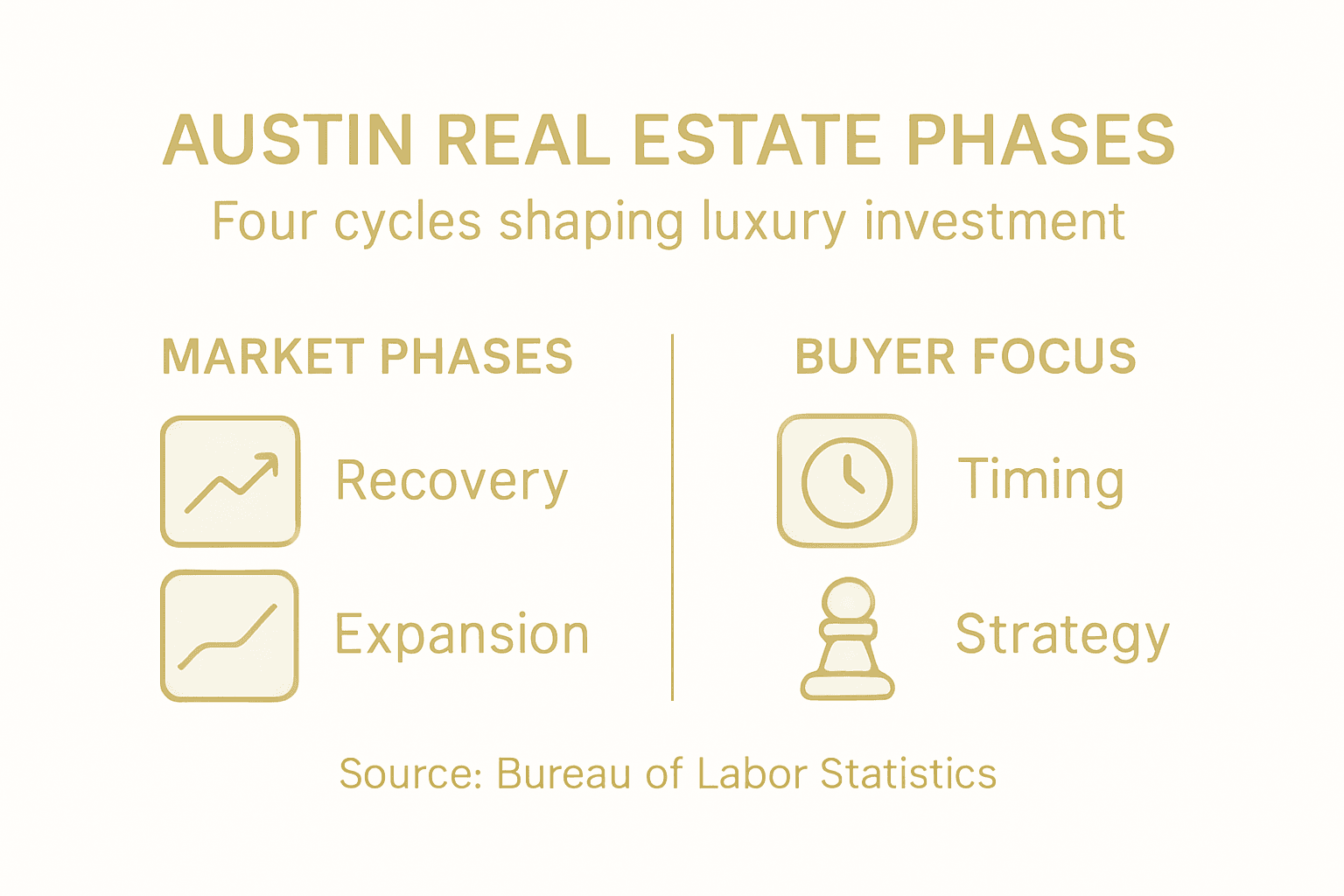
Here’s how the four market phases compare for Austin luxury real estate:
| Market Phase | Typical Buyer Activity | Price Trend | Key Investor Focus |
|---|---|---|---|
| Recovery | Cautious re-entry | Stabilizing | Value opportunities |
| Expansion | Active, competitive | Increasing | Rapid appreciation |
| Hyper Supply | Selective, analytical | Peaking or volatile | Risk assessment |
| Recession | Minimal, wait-and-see | Declining | Preservation of capital |
Pro tip: Develop a nuanced investment strategy that accounts for multiple market phases, allowing flexibility and strategic positioning across different economic environments.
Distinct Traits of Austin’s Luxury Market Cycle
Austin’s luxury real estate market defies conventional market patterns, presenting a unique ecosystem driven by sophisticated economic dynamics. Luxury property market trends reveal intricate characteristics that set this segment apart from traditional real estate investments.
The most prominent distinct traits of Austin’s luxury market include:
- Heightened Economic Sensitivity: Luxury properties respond more dramatically to economic shifts
- Limited Inventory: Exclusive properties create scarcity-driven pricing dynamics
- High-Value Migration Patterns: Affluent professionals driving demand through relocation
- Technology and Innovation Impact: Tech sector growth directly influencing property values
- Investment-Driven Purchasing: More strategic, long-term investment considerations
According to Bureau of Labor Statistics economic data, Austin’s metropolitan economic landscape creates a distinctive environment for luxury real estate. The city’s robust job market, particularly in technology and creative sectors, generates unique demand characteristics that differentiate its luxury market from other urban centers.

These nuanced market traits demonstrate that Austin’s luxury real estate is not just about property, but a complex interplay of economic innovation, demographic shifts, and strategic investment opportunities. Successful luxury buyers must understand these intricate dynamics to navigate the market effectively, recognizing that traditional investment strategies may not apply in this distinctive ecosystem.
Pro tip: Develop a comprehensive understanding of Austin’s economic indicators and technology sector trends to anticipate luxury market movements before they become apparent to other investors.
Major Influences: Economy, Migration, and Policy
Austin’s real estate market operates within a complex ecosystem where economic dynamics, migration patterns, and policy decisions intersect to create unique investment landscapes. Economic policy impacts demonstrate how interconnected these factors have become in shaping luxury property trends.
The key influences driving Austin’s real estate market include:
- Economic Diversity: Robust technology and creative sector job markets
- Migration Trends: Influx of high-income professionals
- Policy Frameworks: Zoning regulations and development incentives
- Innovation Ecosystem: Startup culture attracting global talent
- Demographic Shifts: Changing population composition and preferences
According to Austin’s population change analysis, migration remains a critical driver of real estate dynamics. The city’s ability to attract talented professionals from technology, creative industries, and emerging sectors creates a unique demand profile that distinguishes Austin from other metropolitan markets.
These influences create a nuanced market where traditional real estate investment strategies must be reimagined. Luxury buyers must understand that Austin’s market is not just about property transactions, but about participating in a dynamic economic ecosystem that continuously evolves through complex interactions between economic, demographic, and policy-driven factors.
The following table summarizes how major influences affect Austin’s luxury market:
| Influence | Impact on Luxury Market | Example Effect |
|---|---|---|
| Economic Diversity | Drives resilient demand | Attracts varied high-end buyers |
| Migration Trends | Shifts property preferences | Spurs growth in luxury suburbs |
| Policy Frameworks | Alters development opportunities | Modifies zoning for new projects |
| Innovation Ecosystem | Elevates property values | Tech expansions fuel price hikes |
| Demographic Shifts | Changes luxury amenity priorities | Younger buyers seek modern design |
Pro tip: Develop a comprehensive understanding of Austin’s economic indicators, migration trends, and policy landscapes to anticipate market shifts before they become mainstream investment knowledge.
Risks, Opportunities, and Timing Strategies
Navigating Austin’s luxury real estate market requires a sophisticated understanding of strategic investment timing and potential market vulnerabilities. Housing market analysis reveals complex dynamics that sophisticated investors must carefully evaluate before making significant property decisions.
Key strategic considerations include:
- Market Volatility: Understanding cyclical economic fluctuations
- Interest Rate Sensitivity: Impact of federal monetary policies
- Inventory Dynamics: Supply and demand imbalances
- Technology Sector Influence: Job market disruptions and growth patterns
- Migration Trend Forecasting: Predicting population shifts
According to Bureau of Labor Statistics economic indicators, luxury real estate investments require nuanced timing strategies that go beyond traditional market entry points. The interconnected nature of employment trends, wage growth, and property valuations creates a multifaceted landscape for potential investors.
Successful luxury buyers recognize that risk management is not about avoiding uncertainty, but strategically positioning investments to capitalize on market transitions. The most effective approach involves continuous monitoring of economic indicators, technological disruptions, and demographic shifts that can create unexpected opportunities in Austin’s dynamic real estate ecosystem.
Pro tip: Develop a dynamic investment strategy that treats market risks as potential opportunities, maintaining flexibility to pivot quickly as economic conditions evolve.
Master Austin’s Luxury Real Estate Cycle with Expert Guidance
Navigating Austin’s complex real estate cycle requires more than just basic market knowledge. The article highlights key challenges faced by luxury buyers such as understanding market phases like expansion and hyper supply, interpreting migration trends, and anticipating economic shifts. These factors can create uncertainty and risk when timing high-value investments. If you want to transform these challenges into strategic opportunities, you need personalized insights grounded in data-driven strategies and deep local expertise.
Unlock the full potential of Austin’s luxury market by partnering with the Mogavero Group. Founded by Mike Mogavero, our design-driven team blends architecture-minded marketing with meticulous market preparation to position your investment for success. Whether you are buying or selling in Westlake, Tarrytown, or other premier neighborhoods, we provide white-glove guidance tailored for the evolving Austin market. Ready to make informed moves with confidence. Visit Mogavero Group now and stay ahead of Austin’s dynamic real estate cycle.
Frequently Asked Questions
What are the phases of Austin’s real estate market cycle?
Austin’s real estate market cycle includes four main phases: Recovery, Expansion, Hyper Supply, and Recession, each influencing buyer strategies and property values.
How do economic conditions affect luxury property values in Austin?
Luxury property values in Austin are highly sensitive to economic shifts, including job market dynamics and technological growth, which drive demand and pricing.
What are the risks and opportunities for luxury buyers in Austin’s real estate market?
Luxury buyers face risks from market volatility and interest rate changes, but also opportunities from strategic timing and understanding market dynamics that can enhance their investments.
Why is understanding migration trends important for luxury real estate investors?
Understanding migration trends helps luxury real estate investors anticipate shifts in demand and preferences, particularly from affluent professionals relocating to Austin.