Luxury Home Privacy: Essential Solutions for 2026
Protecting your peace of mind in Austin’s most sought-after neighborhoods requires more than a beautiful address or cutting-edge amenities. Privacy for high-net-worth buyers has evolved into a non-negotiable requirement, especially as luxury homes now face increased risks of intrusion and unwanted attention. This guide reveals how thoughtful design, innovative technology, and strategic landscaping deliver comprehensive privacy worthy of your investment while supporting the comfort and exclusivity you expect from Austin luxury real estate.
Table of Contents
- Defining Luxury Home Privacy In 2026
- Key Features And Modern Innovations
- Types Of Privacy Solutions For Luxury Homes
- Risks, Costs, And Common Pitfalls
- Best Practices For Secure, Discreet Living
Key Takeaways
| Point | Details |
|---|---|
| Luxury Home Privacy is Essential | In 2026, privacy is no longer just desired; it’s a critical requirement for high-net-worth homebuyers. Understanding modern privacy elements is vital for informed investments. |
| Holistic Privacy Approach | True luxury privacy incorporates architectural design, landscaping, and technology, providing comprehensive seclusion and security. |
| Layered Privacy Solutions | Effective privacy combines natural barriers, design features, and smart technology to create sustainable and elegant seclusion for luxury homes. |
| Maintaining Privacy Investment | Homeowners should budget for ongoing privacy maintenance and upgrades to ensure long-term protection against emerging threats. |
Defining Luxury Home Privacy in 2026
Privacy in luxury homes has transformed from a simple desire into a fundamental requirement. For high-net-worth individuals considering purchases in Austin’s most coveted neighborhoods, understanding what privacy truly means today is essential to making informed decisions about your investment.
Luxury home privacy in 2026 encompasses far more than closing your curtains. It involves a comprehensive approach integrating architectural design, technology, landscaping, and neighborhood positioning to create genuine seclusion without sacrificing the lifestyle benefits your home provides.
What Modern Privacy Really Means
Privacy for luxury homeowners today addresses three distinct concerns:
- Visual privacy: Controlling who can see into your home and your property from neighboring homes, streets, or aerial views
- Acoustic privacy: Minimizing sound transmission from outside and preventing interior conversations from carrying beyond your walls
- Access privacy: Managing who can physically reach your property and the level of security surrounding your gates, grounds, and entry points
The definition has shifted dramatically because wealth visibility has increased. Creating a safe haven through architectural strategies like strategic landscaping, window placement, and soundproofing allows you to control visibility while maintaining comfort and views.
Why 2026 Privacy Demands Are Different
Historically, luxury homes originated as aristocratic mansions symbolizing wealth and comfort. Today, privacy represents something far more critical: protection and peace of mind in an increasingly connected world.
Privacy has become a mandatory right alongside comfort and aesthetics. Drones, social media, public property records, and real estate marketing have created unprecedented exposure for high-net-worth homeowners. What once seemed private is now potentially visible to anyone with a camera or internet connection.
Privacy in 2026 isn’t optional—it’s a non-negotiable requirement for luxury home buyers seeking genuine seclusion and security.
Privacy as a Luxury Marker
When evaluating properties in Westlake, Tarrytown, or Rollingwood, privacy has become a primary luxury indicator. Unlike finishes or square footage, true privacy cannot be easily replicated or purchased after purchase.
Properties offering natural seclusion through topography, mature landscaping, or strategic positioning command premium valuations. A home with limited sight lines from neighboring properties, streets, and aerial views demonstrates sustainable privacy—not dependent on technology or active maintenance.
The sophistication of your privacy solutions reflects the overall quality of your home. Strategic window placement, soundproofing materials, and landscape design represent intentional, high-level planning that separates truly luxury homes from standard luxury homes.
Key Privacy Considerations for 2026
When assessing luxury homes, evaluate privacy across multiple dimensions:
- Property positioning: Distance from neighbors, street visibility, and lot orientation
- Natural barriers: Mature trees, elevation changes, water features, or topography creating inherent seclusion
- Design sophistication: Thoughtful architectural choices that balance views with privacy
- Technology readiness: Infrastructure supporting modern security and privacy systems
- Neighborhood dynamics: Community gates, deed restrictions, or development patterns protecting privacy
Each factor contributes to your overall privacy profile. Homes with multiple privacy layers—natural barriers plus thoughtful design plus technology infrastructure—offer genuine, lasting seclusion.
Pro tip: When touring luxury homes, spend time assessing privacy from multiple vantage points: neighboring properties, the street, and if possible, from aerial perspectives, to understand your true visibility exposure.
Key Features and Modern Innovations
Luxury home privacy in 2026 isn’t just about walls and gates anymore. Modern solutions blend architectural intelligence, cutting-edge technology, and strategic design to create layered privacy that responds to real threats while enhancing your living experience.
The most effective privacy strategies combine multiple approaches. A home with natural topography, mature landscaping, and smart design will always outperform one relying solely on technology or fences.
Architectural and Design Solutions
Strategic window placement and landscaping control sightlines while preserving light and views—a critical balance for luxury homeowners. The goal isn’t darkness or isolation; it’s intentional visibility management.
Architectural privacy includes:
- Topography utilization: Using elevation changes to naturally block sightlines from neighbors and streets
- Strategic landscaping: Mature trees, hedges, and water features creating organic visual barriers
- Interior zone separation: Positioning public spaces (living areas, kitchens) away from neighboring properties while clustering private spaces (bedrooms, studies) in protected locations
- Window design: Placing windows strategically to maximize interior light while minimizing external exposure
This approach addresses the needs of ultra-high-net-worth homeowners whose properties require privacy matching their visibility and value.
Smart Home and Technology Integration
The luxury real estate market is shifting toward integrated smart home security systems that enhance discretion and safety without appearing intrusive. Modern buyers demand homes offering seclusion and access control alongside comfort.
Advanced privacy technology includes:
- Smart access systems: Keypad entry, biometric locks, and license plate recognition limiting unauthorized access
- Perimeter monitoring: Motion-activated systems and intelligent cameras that distinguish between threats and delivery personnel
- Window treatments: Automated smart glass and motorized shades controlling visibility in seconds
- Network security: Robust systems protecting your smart home data from external access
The critical difference in 2026 is that technology enhances privacy without compromising lifestyle. Your home should feel open and luxurious, not fortified.
Natural Barriers and Landscaping
Mature landscaping remains the most elegant privacy solution. Trees planted 20 years ago provide seclusion no fence can match. When evaluating properties in Austin’s luxury neighborhoods, assess the maturity and strategic placement of existing vegetation.
The best privacy solutions layer architectural design, natural barriers, and technology together for comprehensive, sustainable seclusion.
Natural barriers offer advantages technology cannot:
- Year-round visual screening
- Sound dampening through density and mass
- Enhanced property aesthetics and market value
- Low maintenance once established
- Privacy that doesn’t feel institutional
Properties with mature trees commanding significant view corridors demonstrate premium privacy planning from original development.
Privacy-First Architectural Design
True luxury homes incorporate privacy into foundational design rather than adding it afterward. This means lot positioning, home orientation, and internal layouts all serve privacy objectives from the start.
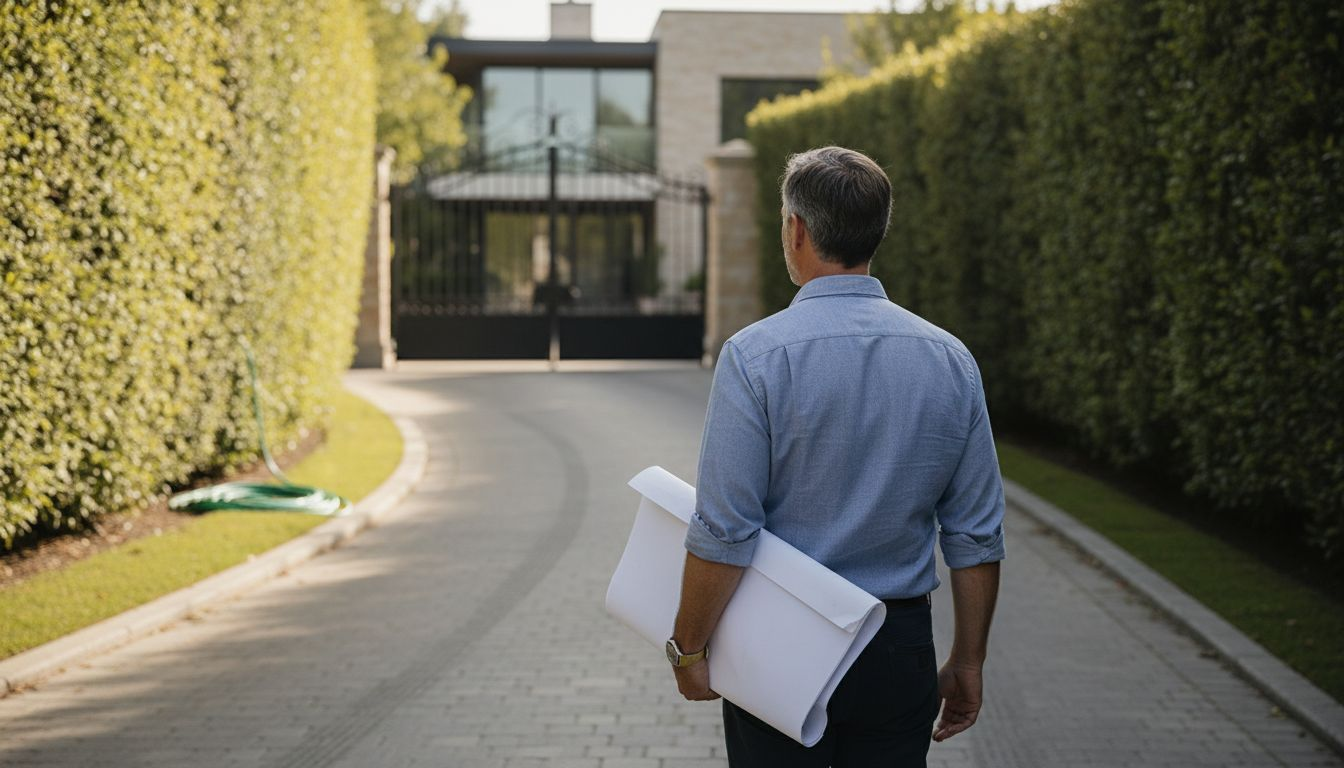
Notice how entry sequences work in luxury homes. Long driveways, strategically placed gates, and curved approaches prevent direct sightlines from streets. Interior layouts separate guest areas from private family spaces. Master suites position away from public views.
These design choices represent intentionality that cannot be retrofit easily. They form part of your home’s permanent privacy infrastructure.
Pro tip: During showings, walk your intended property’s perimeter at different times of day and from neighboring properties to understand actual visibility exposure rather than relying solely on architectural drawings.
Types of Privacy Solutions for Luxury Homes
Privacy solutions for luxury homes aren’t one-size-fits-all. Your approach depends on your specific threats, property characteristics, and lifestyle priorities. The most successful strategies combine multiple solution types working together.
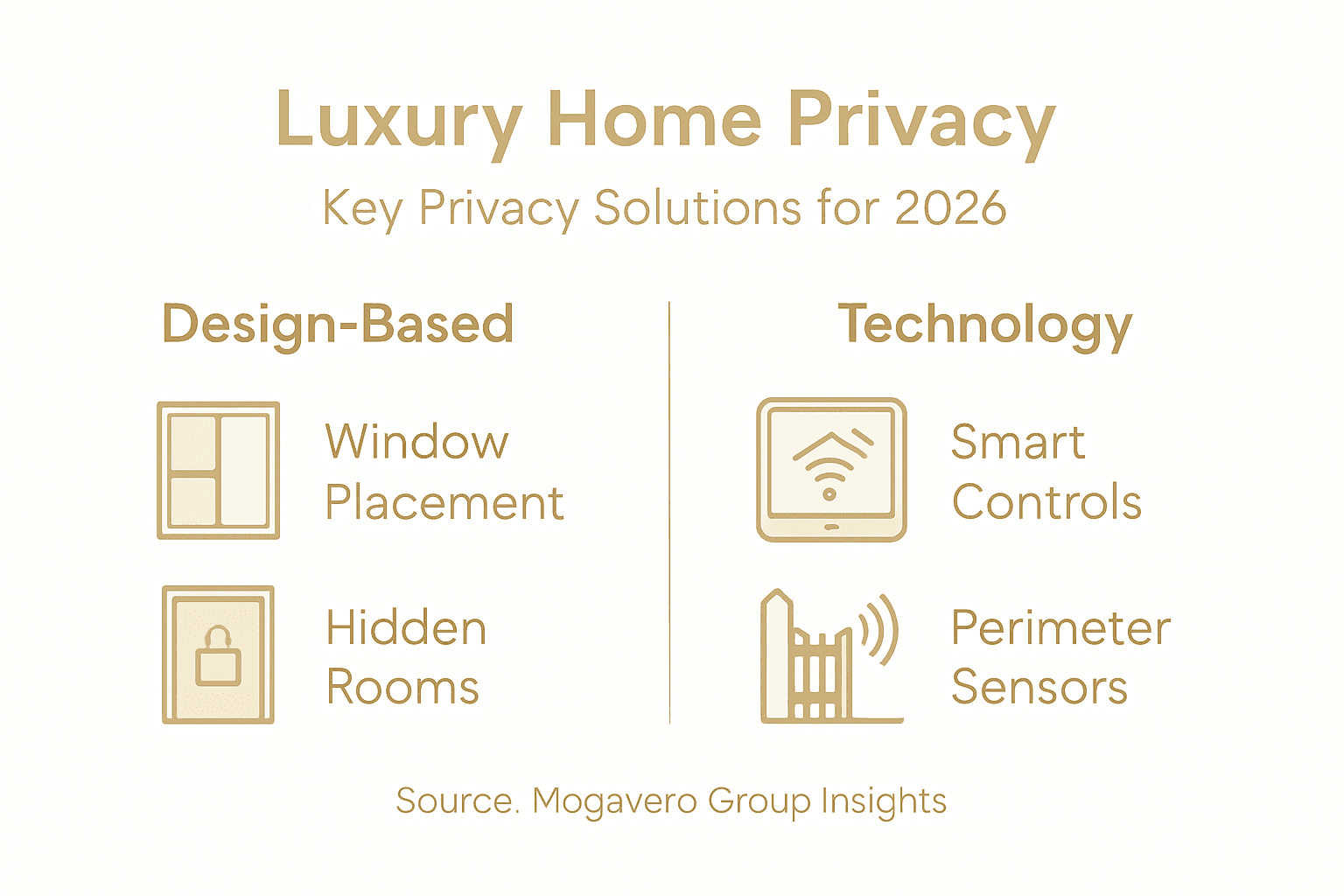
Think of privacy as layers. Remove one layer and your seclusion weakens. Stack them effectively and you create comprehensive protection that feels seamless to daily living.
Here’s a quick comparison of privacy solutions for luxury homes in 2026:
| Privacy Solution Type | Main Advantage | Limitation | Typical Cost Range |
|---|---|---|---|
| Natural Barriers | Elegant, permanent seclusion | Slow to mature, weather-dependent | $50,000 to $250,000+ |
| Architectural Design | Custom integrated protection | Requires early planning, costly | $75,000 to $500,000+ |
| Smart Technology | Real-time control and alerts | Maintenance, potential cyber risks | $40,000 to $200,000 |
| Hidden/Secure Spaces | Total isolation for valuables | Limited usability, expensive | $50,000 to $300,000+ |
Physical and Perimeter Security
Physical barriers form your first line of defense. These include gates, walls, fences, and strategic landscaping that control who can access your property.
Effective perimeter solutions involve:
- Entry point control: Gated driveways with controlled access preventing unauthorized approach
- Visual screening: Fencing and landscaping blocking sightlines from streets and neighboring properties
- Boundary definition: Clear property lines with mature vegetation creating natural separation
- Access layering: Multiple gates or checkpoints slowing unauthorized entry
The most elegant perimeter solutions appear natural rather than fortress-like. Mature hedgerows and stone walls provide security while enhancing aesthetic appeal.
Architectural and Design-Based Privacy
Architectural solutions integrate privacy into your home’s fundamental structure. Multi-layered approaches combine strategic landscaping with secured perimeters and controlled access points tailored to affluent homeowners’ unique needs.
Key architectural strategies include:
- Entry sequence design: Long driveways and curved approaches preventing direct sightlines
- Window positioning: Strategic placement limiting visibility from neighboring properties
- Interior zoning: Separating public entertaining spaces from private family areas
- Outdoor room design: Enclosed courtyards and terraces creating private outdoor living
These solutions work because they address privacy at the design phase rather than retrofitting later.
Specialized Spaces: Hidden Rooms and Secure Areas
Luxury homes increasingly incorporate hidden rooms and secret spaces for work, wellness, and storage that fulfill complex privacy demands. These specialized areas allow uninterrupted activities and serve as peaceful escapes beyond conventional barriers.
Common specialized spaces include:
- Private offices: Soundproofed work areas isolated from guest visibility
- Home wellness centers: Spa rooms, meditation spaces, or fitness areas with complete discretion
- Secure storage: Climate-controlled vaults for valuables, documents, or collections
- Entertainment suites: Private screening rooms or gaming spaces separate from main living areas
Specialized spaces represent the intersection of privacy, functionality, and luxury—offering uninterrupted sanctuary within your home.
Technology-Based Privacy Solutions
Smart home technology enhances privacy when deployed thoughtfully. Systems should operate invisibly, protecting you without requiring constant monitoring or creating an institutional feel.
Technology components include:
- Smart surveillance: Discreet cameras with facial recognition distinguishing family, staff, and threats
- Access control: Biometric systems, smart locks, and encrypted entry logging
- Perimeter monitoring: Motion sensors and intelligent alerts
- Communication systems: Integrated intercoms allowing discrete household coordination
The critical principle: technology amplifies your privacy intentions without replacing thoughtful design.
Comprehensive Privacy Strategies
Effective privacy combines all solution types. A property with excellent gates but poor window placement still has vulnerabilities. Strong architectural design paired with mature landscaping and discreet technology creates genuine, sustainable seclusion.
When evaluating different types of luxury homes, assess how each addresses privacy holistically rather than relying on single solutions.
Pro tip: Request a privacy assessment from your real estate advisor before purchasing, evaluating perimeter security, architectural design, natural barriers, and technology infrastructure together to identify gaps in comprehensive protection.
Risks, Costs, and Common Pitfalls
Privacy protection for luxury homes requires significant investment and careful planning. Understanding the real risks, realistic costs, and common mistakes helps you avoid expensive missteps and genuine vulnerabilities.
Many luxury homeowners underestimate what comprehensive privacy actually requires. They focus on visible elements while missing critical gaps that create exposure.
Real Risks Facing Luxury Homeowners
Your increased wealth visibility creates specific threats. Increased visibility leading to threats such as intrusion, theft, stalking, and potential harm represents the core challenge luxury homeowners face in modern markets.
Luxury properties face unique threats:
- Targeted break-ins: Criminals research properties and timing, not random burglaries
- Data breaches: Smart home systems and connected devices create cyber vulnerabilities
- Unwanted attention: Social media, public records, and real estate marketing expose your location and wealth
- Stalking and surveillance: Individuals monitoring your patterns and routines
- Kidnapping risks: High-net-worth families targeting family members
These aren’t paranoid concerns. They’re documented risks requiring documented solutions.
The table below summarizes risks facing luxury homeowners and recommended mitigation approaches:
| Risk Type | Description | Mitigation Strategy |
|---|---|---|
| Targeted break-ins | Planned theft with research | Perimeter security, monitoring |
| Data breaches | Cyber attacks via smart systems | Robust network protection |
| Unwanted attention | Public exposure via records or media | Discreet property positioning |
| Stalking | Surveillance of routines | Access control, response plans |
| Kidnapping risks | Threats to family safety | Integrated physical and tech layers |
Understanding Privacy and Security Costs
Comprehensive privacy requires meaningful financial commitment. Costs span installation, maintenance, upgrades, and professional monitoring across multiple years.
Typical investment ranges include:
- Landscaping and hardscaping: $50,000 to $250,000+ for mature plantings and perimeter work
- Gate and access systems: $30,000 to $150,000 for quality installations
- Smart home security: $40,000 to $200,000 including cameras, sensors, and integration
- Architectural modifications: $75,000 to $500,000+ for window treatments, soundproofing, or room redesigns
- Ongoing monitoring: $1,500 to $5,000 monthly for professional security services
These investments often prove impossible to recover at resale. Budget for privacy as lifestyle cost, not investment appreciation.
Common Pitfalls Luxury Homeowners Make
Luxury homeowners face unique risks necessitating robust and often costly measures, with pitfalls including reliance on outdated technology and failure to tailor solutions to specific property needs that create unexpected vulnerabilities.
Frequent mistakes include:
- Treating privacy as afterthought: Adding security to poorly designed homes creates visible, awkward installations
- Over-relying on technology: Smart systems fail, require maintenance, and create cyber vulnerabilities when not balanced with physical design
- Neglecting integrated approaches: Installing cameras without addressing sightlines or adding gates without entry sequence design leaves gaps
- Ignoring maintenance: Security systems degrade; landscaping changes; outdated technology stops functioning
- Underestimating lifestyle impact: Heavy-handed security measures make homes feel institutional rather than luxurious
The costliest privacy mistake is treating it as separate from design rather than foundational to how your home actually works.
The Integration Problem
Most luxury homeowners fail at privacy not from insufficient budget, but from poor coordination. Your architect designs one way, your technology specialist installs another, and your landscaper works independently.
Effective privacy requires integrated planning from the start. Every decision—lot positioning, window placement, driveway routing, landscaping strategy, and technology infrastructure—must serve unified privacy objectives.
Properties designed around privacy from inception outperform properties where security was retrofitted later.
Long-Term Maintenance and Upgrade Costs
Privacy solutions require ongoing investment. Landscaping matures and requires management. Technology becomes outdated and needs replacement. Security protocols evolve as threats change.
Budget 10-15% annually of your initial privacy investment for maintenance, upgrades, and professional monitoring. This ongoing commitment often surprises homeowners who assumed privacy was a one-time installation.
Pro tip: Before purchasing a luxury property, request a comprehensive privacy audit identifying all gaps and estimated total costs for complete protection—installation plus five years of maintenance and monitoring—to avoid budget shock after closing.
Best Practices for Secure, Discreet Living
Secure, discreet living in a luxury home combines thoughtful design, strategic planning, and lifestyle discipline. The most effective approach integrates privacy across every decision rather than treating security as an afterthought.
Your privacy is only as strong as your weakest practice. One visible mistake can undo years of careful planning.
Planning Privacy from the Beginning
Early-stage architectural planning that considers topography, sightlines, and natural barriers forms the foundation for sustainable privacy. Integrating landscaping strategically and optimizing window placement enhance privacy without compromising aesthetics or your quality of life.
Best practices during property selection and design include:
- Evaluate lot topography: Choose properties with natural elevation changes blocking sightlines
- Assess sightline exposure: Understand visibility from neighboring properties, streets, and aerial perspectives
- Plan landscaping strategically: Mature trees and vegetation create lasting privacy versus artificial barriers
- Position buildings thoughtfully: Locate your home to maximize natural screening from neighboring properties
- Design entry sequences: Long driveways and curved approaches prevent direct sightlines from public roads
These decisions made during design phase prove impossible to correct after construction.
Interior Layout and Zone Separation
Your home’s interior organization directly impacts privacy. Separate public zones (guest areas, entertaining spaces) from private zones (bedrooms, offices, family spaces) to maintain discretion from visitors and staff.
Key layout strategies include:
- Guest circulation: Design visitor routes avoiding private family areas
- Service access: Create separate entrances and pathways for household staff and service providers
- Window positioning: Place windows in private areas away from neighboring sight lines
- Interior privacy: Use operable partitions and strategic door placement controlling who sees what
Thoughtful layout means guests never glimpse your family’s private moments. This architectural discretion feels natural rather than restrictive.
Technology That Blends, Not Dominates
Secure and discreet luxury living combines privacy and security through design and technology, incorporating advanced surveillance systems that blend with the environment while ensuring controlled access without appearing institutional.
Effective technology practices:
- Conceal cameras and sensors: Mount systems discretely rather than obviously
- Integrate smart systems: Hidden intercoms, automated gates, and access controls operating invisibly
- Minimize outdoor equipment: Bury cables, position boxes away from sight lines, use camouflage finishes
- Regular maintenance protocols: Outdated or malfunctioning systems create vulnerabilities
Your technology should enhance your lifestyle invisibly. Visitors shouldn’t feel monitored; they should feel secure.
Lifestyle and Discretion Practices
Privacy extends beyond physical infrastructure to how you live. Controlled access to information, consistent routines, and managed visibility protect you continuously.
The most secure homes combine architectural excellence with disciplined lifestyle practices that maintain consistent privacy.
Discretion-focused living involves:
- Limited staff exposure: Vet carefully and maintain professional boundaries
- Delivery coordination: Require advance notice and use service entrances
- Guest management: Control who visits and when they visit
- Social media awareness: Never post location details or real-time activities
- Routine variation: Avoid predictable patterns in your schedule and movements
Material Selection and Long-Term Durability
Select materials supporting security objectives. Soundproofing in walls, security-grade glass, and durable landscaping require minimal maintenance while providing lasting protection.
Material considerations include:
- Acoustical materials: Soundproof walls and specialized glazing minimize sound transmission
- Security glass: Tempered and laminated options resisting forced entry
- Landscaping durability: Native species requiring less maintenance while providing year-round screening
- Gate and fence quality: Heavy-gauge materials resisting cutting tools and weathering
Investing in quality materials during initial construction proves far cheaper than replacing degraded systems.
Pro tip: Create a comprehensive privacy operations manual documenting all security protocols, technology access codes, staff procedures, and maintenance schedules—then review and update it annually to ensure your systems remain current and effective.
Elevate Your Privacy Strategy with Expert Guidance in Austin Luxury Homes
Privacy in luxury homes today demands more than just walls and gates. The article highlights the critical challenges of achieving visual, acoustic, and access privacy through thoughtful architectural design, mature landscaping, and integrating smart technology. For high-net-worth buyers in Austin neighborhoods like Westlake and Tarrytown, balancing these layers of seclusion while maintaining elegance and lifestyle comfort is an urgent priority.
At Mogavero Group, we understand that true privacy must be built into your home’s foundation and its positioning within the community. Founded by Mike Mogavero, our team excels at architecture-minded positioning and leveraging data-backed strategies to find properties where privacy aligns seamlessly with luxury living. Whether you are seeking a secluded estate or a residence designed for discreet living and comprehensive security, our white-glove guidance ensures your investment protects your lifestyle and peace of mind. Explore how our expert approach can tailor privacy to your unique needs today at Mogavero Group and take the first step toward securing your sanctuary in Austin’s premier luxury markets.
Frequently Asked Questions
What are the key components of luxury home privacy in 2026?
Luxury home privacy in 2026 includes visual privacy, acoustic privacy, and access privacy, protecting homeowners from unwanted observation, sound transmission, and unauthorized access.
How can architectural design enhance privacy in luxury homes?
Architectural design can enhance privacy through strategic window placements, thoughtful spacing of public and private areas, and utilizing natural topography and landscaping to create visual barriers and reduce sightlines from neighbors.
What role does technology play in ensuring privacy for luxury homeowners?
Technology plays a critical role by integrating smart home security systems, such as automated access controls, perimeter monitoring, and discreet surveillance cameras, all designed to enhance privacy without compromising the luxurious feel of the home.
Why is it important to consider privacy when purchasing a luxury home?
Considering privacy is essential because it significantly impacts lifestyle, comfort, and security. Homes with intrinsic privacy features command higher valuations and offer protection from unwanted attention, intrusion, and other risks associated with increased wealth visibility.