
Real Estate Storytelling: Elevating Austin Investments

Moving from New York or San Francisco, you realize that buying a luxury home in Austin is about more than price per square foot. The story behind a property can shape your investment confidence and influence whether a listing stands out or fades into the background. Building emotional connections through authentic and data-driven storytelling helps turn neighborhoods like Tarrytown or Westlake into destinations that match your vision, offering both financial upside and a sense of belonging you can truly trust.
Table of Contents
- Defining Real Estate Storytelling And Misconceptions
- Key Types And Applications In Real Estate
- Core Elements Of Story-Driven Marketing
- Impact On Buyer Engagement And Property Value
- Risks, Compliance, And What To Avoid
Key Takeaways
| Point | Details |
|---|---|
| Importance of Storytelling | Real estate storytelling goes beyond features, fostering emotional connections that influence buyer decisions. |
| Types of Narratives | Data-driven, community-centered, and aspirational narratives serve distinct purposes in marketing properties. |
| Ethics and Compliance | Authentic storytelling must adhere to legal standards, ensuring transparency and verifiability to maintain buyer trust. |
| Impact on Value | Compelling narratives increase perceived value, leading to quicker sales and higher prices for properties. |
Defining Real Estate Storytelling and Misconceptions
Real estate storytelling is far more than describing a property’s square footage or listing its amenities. It’s about crafting narratives that build emotional connections with potential buyers or investors by connecting them to the lifestyle, community, and investment potential a property represents.
For someone relocating to Austin from a major coastal market, a compelling property story isn’t just nice to have—it’s essential. It transforms how you perceive an investment opportunity and helps you understand why a particular home or neighborhood aligns with your values and goals.
What Storytelling Actually Is
Effective real estate storytelling accomplishes several critical things:
- Creates trust through authentic, relatable narratives rather than sales tactics
- Simplifies complex market data into human-centered language your brain naturally processes
- Connects you emotionally to a property’s potential before walking through the door
- Differentiates premium investments from commoditized listings
- Reflects genuine market realities without oversimplifying nuance
When you hear “Tarrytown on Lake Austin,” storytelling doesn’t just mean saying “waterfront property with city views.” It means painting why this specific location matters to your next chapter—proximity to Westlake amenities, the developer-designed architecture, the community’s selective nature.
Authentic storytelling shapes how investors perceive market opportunities and influences confidence in their decisions. Narratives must reflect reality, not create misleading impressions of complex real estate dynamics.
Common Misconceptions About Real Estate Storytelling
Most people misunderstand what storytelling actually does in real estate. Here’s what it’s not:
Not just feature recitation. Listing “4 bedrooms, 3.5 bathrooms, chef’s kitchen” isn’t storytelling—that’s inventory data. Storytelling explains why these features matter to you specifically and how they enhance your daily life.
Not embellishment or exaggeration. Authentic storytelling requires accuracy. Overstating a property’s potential or masking real limitations damages credibility and creates buyer’s remorse. High net worth individuals recognize manipulation instantly.
Not one-size-fits-all narration. A story that resonates with a tech executive relocating from Silicon Valley differs significantly from one appealing to a C-suite professional from New York. Effective storytelling adapts to your background, priorities, and vision.
Not separate from data. The strongest narratives weave together market trends, neighborhood appreciation patterns, and comparable sales data into a coherent picture. Story and strategy work together, not in opposition.
For luxury investments in markets like Spanish Oaks or Westlake, storytelling bridges the gap between analytical investment criteria and the intangible feeling of “belonging” to a community.
Pro tip: When evaluating a property story, ask whether it reflects your actual priorities and whether supporting data backs the narrative—not whether it sounds impressive.
Key Types and Applications in Real Estate
Real estate storytelling manifests in several distinct types, each serving different purposes depending on your investment stage and market position. Understanding these variations helps you recognize which narrative approach aligns with your goals—whether you’re buying your first luxury home in Westlake or evaluating a portfolio expansion in Spanish Oaks.
Data-Driven Investment Narratives
Data-driven storytelling combines market analytics with human context. Instead of simply stating “Austin’s real estate appreciated 12% year-over-year,” this type explains why—tech job growth, limited inventory, remote work patterns reshaping demand. When predictive analytics inform storytelling, you gain confidence in long-term appreciation potential.
This approach is critical for high net worth individuals evaluating investment merit. Numbers alone don’t convince sophisticated investors—context does.

Community and Placemaking Stories
Community-centric narratives focus on belonging rather than features. They explore neighborhood character, local infrastructure, schools, and social fabric. For someone relocating from New York or Silicon Valley, these stories answer the unspoken question: “Will I actually fit here?”
Placemaking storytelling transforms Tarrytown or Rollingwood from geographic locations into communities with identity and purpose.
- Highlight neighborhood history and evolution
- Emphasize local amenities and access patterns
- Showcase resident profiles and lifestyle alignment
- Connect environmental or social values to the property
Aspirational Lifestyle Narratives
This type paints the life you’ll live in the property. Not “pool and outdoor kitchen,” but “summer dinners overlooking Lake Austin” or “weekend mornings in your private study with city views.” Aspirational storytelling creates emotional bonds that transcend rational evaluation.
For luxury properties, lifestyle storytelling justifies premium pricing because it sells the experience, not the structure.
Here’s a summary contrasting key types of real estate storytelling and their strategic effects:
| Type of Narrative | Core Focus | Typical Audience | Strategic Impact |
|---|---|---|---|
| Data-Driven | Market analytics, context | Investors, analysts | Increases confidence, supports valuation |
| Community/Placemaking | Social fabric, belonging | Relocators, families | Fosters emotional fit, builds trust |
| Aspirational Lifestyle | Future lifestyle vision | Luxury buyers | Drives emotional attachment, justifies premium pricing |
Applications Across the Investment Journey
You’ll encounter real estate storytelling at multiple decision points:
- Market evaluation – Understanding why a neighborhood or asset class deserves your attention
- Property assessment – Connecting physical features to your actual daily life
- Negotiation positioning – Recognizing how a property’s story influences perceived value
- Portfolio strategy – Evaluating how new acquisitions fit your investment narrative
The strongest real estate narratives weave data, community context, and personal aspiration into a coherent story that feels authentic to both the property and your vision.
When evaluating properties, ask yourself: Does this story align with my relocation goals? Is it backed by real market dynamics? Does it reflect the community I want to join?
Pro tip: Request specific data supporting any property story you’re considering—appreciation trends, neighborhood demographics, comparable sales. The best narratives combine compelling vision with verifiable reality.
Core Elements of Story-Driven Marketing
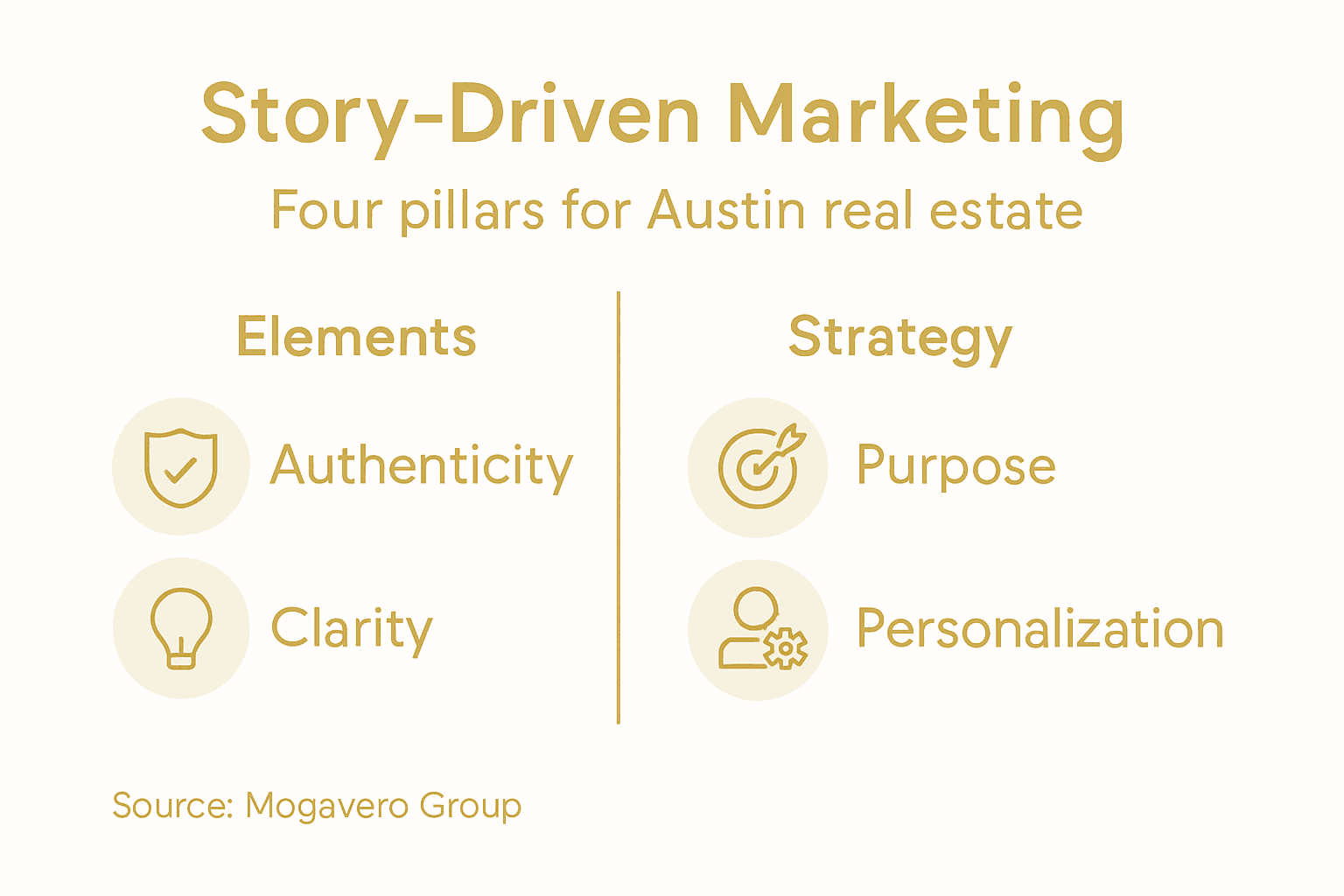
Effective story-driven marketing in real estate rests on four foundational pillars. These elements work together to transform a listing from a commodity into a compelling investment opportunity that resonates with high net worth relocators and seasoned investors alike.
Authenticity and Transparency
Authenticity means the story reflects actual client experiences, verified property history, or documented neighborhood evolution. For luxury properties in Westlake or Tarrytown, authenticity builds credibility that generic marketing cannot achieve.
Transparency goes hand-in-hand with authenticity. Authentic narratives evoke emotion while building trust through honest representation rather than manipulation. When a property has genuine constraints—awkward lot size, older systems requiring updates—authentic storytelling acknowledges these while contextualizing their value within the larger investment picture.
High net worth individuals recognize artifice instantly. Transparent storytelling converts skepticism into confidence.
Emotional Connection and Clarity
Emotional connection doesn’t mean sentiment. It means connecting the property to your values, aspirations, and lifestyle vision. A family relocating from San Francisco doesn’t care about architectural details—they care about whether their kids will thrive and whether the community aligns with their principles.
But emotion without clarity creates confusion. The narrative must be understandable without jargon or oversimplification. Complex market dynamics should inform the story, not obscure it.
Key clarity elements include:
- One clear core message (not five competing angles)
- Specific examples rather than generalizations
- Data supporting emotional claims
- Personalization for your specific background and priorities
Purpose-Driven Strategy
Purpose answers the question: Why tell this particular story to this particular investor? Is the goal to justify premium pricing? Build long-term confidence in appreciation? Differentiate from competing listings? Create urgency around limited inventory?
Without clear purpose, storytelling becomes rambling narrative that loses your attention. Purpose keeps the story focused and aligned with your decision-making criteria.
Multi-Media Presentation and Personalization
Compelling stories transcend text. Relatable narratives require multiple formats—video walkthrough of morning light in the study, drone footage of Lake Austin views, drone footage contextualizing neighborhood density, written market analysis, photographer’s perspective on architectural detail.
Personalization means tailoring presentation to your background. A tech executive values different context than a healthcare executive or finance professional relocating from New York.
Below is a concise reference for core pillars of story-driven real estate marketing and their outcomes:
| Pillar | What It Delivers | Buyer Benefit |
|---|---|---|
| Authenticity | Honest, reality-based stories | Builds trust and credibility |
| Clarity | Simple, supporting data and examples | Reduces confusion, aids decision |
| Purpose | Narratives focused on goals | Aligns with buyer priorities |
| Personalization | Tailored to background and values | Increases relevance and appeal |
The strongest marketing narratives combine authentic information, emotional resonance, crystal clarity, and strategic purpose wrapped in multiple media formats.
When evaluating a property’s story, assess whether it addresses your relocation priorities, provides verifiable support, and feels genuinely aligned with the community you’re considering.
Pro tip: Request the complete story package—market analysis, neighborhood data, comparable sales context, and multimedia materials. The best real estate marketing tells one cohesive story across all platforms.
Impact on Buyer Engagement and Property Value
Compelling storytelling directly influences how buyers perceive and value properties. For high net worth individuals evaluating Austin investments, this translates into tangible financial and emotional returns that extend far beyond standard market appreciation.
How Storytelling Creates Buyer Attachment
Buyer engagement begins when a narrative makes a property feel like home before you ever walk through the door. Rather than seeing generic features, you envision your morning coffee overlooking Lake Austin or hosting board meetings in a Westlake study with natural light flooding the space.
Emotional connections with properties create memorable experiences that drive purchase motivation. This attachment matters because it bridges the gap between rational financial analysis and genuine desire to own the property.
The difference is measurable: properties with compelling narratives generate more qualified inquiries, shorter sales cycles, and higher final prices.
The Valuation Premium
Stories don’t just make properties more appealing—they make them more valuable. When buyers can envision their lives within a space, they’re willing to pay for that emotional satisfaction alongside the physical structure.
This valuation premium manifests in several ways:
- Higher perceived worth relative to comparable properties
- Justification for premium pricing in competitive markets
- Reduced negotiation pressure from buyers
- Faster absorption in inventory-constrained neighborhoods
- Stronger resale potential when the original narrative creates lasting value perception
Beyond Features to Lifestyle and Investment Thesis
Engaging narratives encourage buyers to envision their lives within properties, facilitating deeper attachment and purchase commitment. For relocating executives, this means the story connects the property to your professional success, your family’s wellbeing, and your investment strategy—not just the marble countertops.
A compelling narrative transforms a property purchase from a real estate transaction into a lifestyle decision backed by sound investment reasoning.
Competitive Differentiation
In markets like Tarrytown and Spanish Oaks where multiple comparable properties compete for attention, storytelling creates clear differentiation. Two homes with similar floor plans, lot sizes, and price points become entirely different propositions when one tells a thoughtful story and the other remains a commodity listing.
High net worth buyers have options. They choose properties where the narrative resonates with their values and vision.
Properties with authentic, compelling narratives command premium valuations because buyers recognize value beyond square footage—they’re buying the lifestyle, community fit, and investment confidence the story communicates.
When evaluating properties, pay attention to which listings create genuine excitement versus which ones feel like standard marketing. That distinction often correlates directly with perceived value and resale potential.
Pro tip: Request the full storytelling package from your agent—market context, neighborhood trajectory, comparable analysis, and lifestyle narrative. Premium properties deserve premium presentation that justifies their valuation.
Risks, Compliance, and What to Avoid
Powerful storytelling carries real legal and ethical responsibilities. For high net worth investors, understanding these boundaries protects both your interests and your reputation in Austin’s premium real estate market.
The Compliance Framework
Real estate marketing operates under strict regulatory requirements. Truthful advertising isn’t optional—it’s legally mandated. Any narrative claiming property features, market projections, or neighborhood characteristics must be verifiable and accurate.
Compliance mandates require transparent advertising and factual accuracy to avoid legal penalties and reputational damage. Omitting critical property details—foundation issues, zoning restrictions, flood history—creates legal exposure even when the overall story feels compelling.
When evaluating properties or marketing strategies, verify that every claim has documented support.
Common Pitfalls to Avoid
Exaggeration damages credibility instantly with sophisticated buyers. Here’s what to watch for:
- Overestimating appreciation potential – Claiming a property will appreciate 20% annually without market basis
- Masking property defects – Focusing heavily on location while downplaying required systems updates
- Misrepresenting neighborhood trajectory – Suggesting gentrification is inevitable when evidence is speculative
- Data distortion – Cherry-picking comparable sales or market metrics that misrepresent true value
- Unrealistic lifestyle narratives – Promising outcomes disconnected from actual property characteristics
High net worth buyers recognize manufactured enthusiasm. Authenticity builds trust; exaggeration destroys it.
Ethical Storytelling Versus Manipulation
The line between compelling narrative and misleading claim depends on transparency and verifiability. Risks include misrepresentation and data misinterpretation when storytelling lacks ethical guidelines and accountability measures.
Ethical storytelling acknowledges constraints alongside opportunities. A genuine narrative might describe a property’s current condition honestly while contextualizing its investment potential based on documented market trends and comparable transactions.
Documentation and Accountability
Maintain verifiable documentation supporting every narrative element. Market analysis should reference specific data sources. Neighborhood stories should rest on demographic trends and community development plans. Investment projections should cite comparable sales and appreciation patterns.
This approach protects you legally while building confidence with sophisticated investors who expect substance behind the story.
Ethical real estate storytelling combines authentic narrative with documented evidence, transparency about limitations, and compliance with advertising regulations—creating buyer trust without legal risk.
When working with agents or evaluating properties, request supporting documentation for any significant claims. Legitimate professionals welcome this scrutiny.
Pro tip: Always request comparable sales data, market analysis, and property documentation before accepting any property narrative. Verify claims independently rather than relying solely on seller or agent representations.
Elevate Your Austin Investment with Authentic Real Estate Storytelling
Navigating Austin’s luxury market demands more than just facts and figures. You need a story that connects with your aspirations and investment goals while reflecting genuine market insights. The challenge many face is finding a real estate team that merges data-driven narratives with emotional clarity to create compelling property stories tailored to your unique vision.
At Mogavero Group, founded by Mike Mogavero, we specialize in this artful balance. Our design-driven approach combines a developer’s eye with a marketer’s toolkit, ensuring each home’s narrative highlights architectural distinction, community fit, and verified market dynamics. Whether you are relocating to Westlake or exploring opportunities in Tarrytown and Spanish Oaks, we provide the transparency and purpose-driven storytelling that builds trust and drives confident decisions.
Discover how our meticulous preparation and white-glove service can transform your Austin investment experience.

Start turning properties into personalized stories today. Visit Mogavero Group to learn how our expert team crafts narratives that maximize value and align with your lifestyle and investment priorities. Explore our insights and let us guide you through Austin’s premier neighborhoods like Westlake, Tarrytown, and beyond. Connect now to experience real estate marketing that truly resonates with who you are and where you want to live.
Frequently Asked Questions
What is real estate storytelling?
Real estate storytelling is the process of crafting narratives that connect potential buyers or investors emotionally to a property by illustrating its lifestyle, community, and investment potential.
How does storytelling impact buyer engagement in real estate?
Compelling storytelling helps buyers envision their lives in a property, creating emotional attachments that enhance their motivation to purchase and can lead to shorter sales cycles and higher final prices.
What are the different types of real estate storytelling?
The main types of real estate storytelling include data-driven investment narratives, community and placemaking stories, and aspirational lifestyle narratives. Each serves a unique purpose based on the audience’s needs.
Why is authenticity important in real estate storytelling?
Authenticity is crucial because it builds trust with potential buyers. Stories should reflect actual experiences and property facts; exaggerations can damage credibility and lead to buyer’s remorse.
Recommended
- Austin short term rental investment | Texas STR tax benefits | Big Beautiful Bill real estate impact | bonus depreciation STR | cost segregation Austin rental | East Austin investment property | Parker Lane Austin compound | 108 Comal investment | 1914 E 8th Austin
- Austin Texas Tax Benefits | Move to Austin
- Austin Real Estate | Best Austin Realtor
- Why austin for luxury living | Global Market Austin
- Maximise Equity with Real Estate | Elite Wealth Creators
- 7 Strategic Real Estate Marketing Tips for Dubai Investors